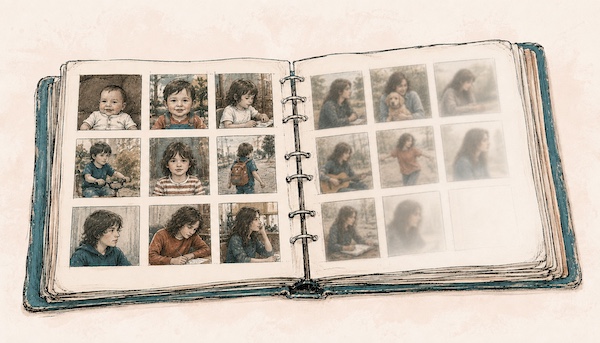
When You Can't Picture Your Trans or Nonbinary Child's Future
Table of Contents
The picture you could always see
What it means when the image goes blank
Every parent is doing this impossible thing
You can picture one of your kids clearly. You see them in ten years — maybe not exactly, but the shape of it is there. A kitchen somewhere, a laugh, the way they'll probably still roll their eyes at you. Something.
Then you try to do that with your trans or nonbinary child, and the image doesn't form. You sit with it for a second, trying. Nothing comes. There's a kind of pressure in your chest where a picture should be.
Or maybe the picture is still there — but every time you imagine it, fear crowds in before you can stay with it.
The picture you were holding — the one you'd been quietly building for years — stopped fitting. And you don't have a new one yet.
For many parents of transgender and nonbinary children, that blank lives closer to disorientation than despair. And it tends to go unspoken — even in the conversations where everything else has been said.
The picture you could always see
Most parents carry a quiet internal image of each of their children's futures. It's not a detailed plan — more like a rough sketch. An outline of who they'll be and how they'll move through the world.
Some sketches were detailed. Others were looser — a happy adult, a person who found their way.
Most of us never sat down to draw it. It formed in passing moments — a remark someone made, something you glimpsed and thought yes, something like that. You adjusted it quietly as they grew, without knowing you were holding it at all.
Either way, it was there. You could close your eyes and get a sense of your child, grown — somewhere in the good future you'd quietly imagined for them.
Then your child came out, and the picture no longer fit. The old one didn't belong anymore, and the new one hadn't formed yet.

What it means when the image goes blank
Some of us have other children we can picture clearly. A sibling, maybe. An older kid whose rough sketch already exists somewhere in our mind. We turn toward our trans or nonbinary child and reach for the same thing — and the image dissolves before it forms.
I don't know if I'm seeing a grown woman, a grown man with their own particular style, something entirely different. I don't know what they'll look like. I don't know what word they'll use for themselves by then. The specific visual that I used to be able to call up — it's gone.
What I've come to understand is this:
I'm grieving a projection I didn't know I was holding.
Not a person. A picture I drew of a person, without realizing I was drawing it.
My child never asked to be in that picture. They just showed up as themselves. We know that, when we stop to think about it. We do it anyway.
For some parents that picture was even more detailed — a daughter in a wedding dress, a child headed toward a particular career, grandchildren running around at family gatherings. The more specific the image, the more visible the loss when it stops fitting.
But here's what that loss helped me see.
The grief of a broken projection and the grief of fully loving your trans child — they're different, but they sit close together. → The Grief That Comes With Fully Loving Your Trans Child
Every parent is doing this impossible thing
No parent can actually see their child's future. We know this. But most of us do it anyway — we build a quiet internal image and carry it forward, and when the future arrives differently than we pictured, we feel something almost like betrayal.
Parents of trans and nonbinary children just meet this moment earlier, and more directly. The image breaks and you can see it break. There's no pretending it held.
Other parents get to keep carrying their picture for years, sometimes decades — until a career change, a divorce, a child who moved far away, a grandchild who never came. It breaks for them too, eventually. Most of them never realize how much they were holding until it's gone.
You're being asked to let go before you know what comes next — and without a replacement already forming. When other pictures break, something usually arrives alongside the loss. Here, there's nothing waiting yet. Just open space.
That's genuinely hard.
If the open space tips into dread rather than possibility, Stop Pre-Suffering is about what to do when that happens.
Trading the picture for a feeling
What I've found — and I didn't arrive at this easily — is that the picture was never really what I needed. What I needed was simpler than that.
I don't try to see my youngest's future anymore. I can't. I don't know what they'll look like, what they'll call themselves, who they'll love, what shape their life will take. I've stopped trying to fill that in.
What I do instead is let myself feel a moment.
I see them smile. Not a specific smile in a specific place — just the particular way they smile when something genuinely delights them. I feel the warmth of that, somewhere in my chest. I get a sense of okay. Of them in a life that's theirs. Of something good being present.
That's it. No details. Just the feeling.
It sounds small. It isn't. Because that feeling — that quiet they're okay — is actually what optimism is. The specific image was just the container I was putting it in. And the container broke. The optimism didn't.
You may not be there yet. You don't have to be. And if you're ever curious what it feels like — close your eyes. Let a moment come — just a moment. Maybe they're laughing. Maybe they're at ease, doing something they love, alive and okay in a world that has room for them. Let whatever comes, come. Let the shape of it arrive without filling in the details.
If a moment comes, let it come. If nothing arrives yet, that's okay too. You're not trying to build a new picture. You're just making room.
That's your child, someday. Not a specific picture — something looser than that. A sense that they're okay.

What quiet optimism actually feels like
Sometimes it arrives on its own — small, unannounced, warmer than you expected. And sometimes it's a quiet decision you keep making, over and over, until it starts to come more easily. Both are okay.
It's catching yourself leaning into what's ahead — not planning it, just feeling forward. A moment when something in you settles, and you just know they're going to be okay.
The specific details disappeared. The feeling didn't.
Some people call that hope — hope for their kid, for the world, for the future, all of it at once. Maybe that's exactly what it is.

If you're sitting with this too — or if you want to talk through what you're carrying —
I offer a free Anchor Call. No agenda, no pitch. Just a conversation.
Visual Transparency: All images in this article were generated via DALL-E to illustrate the concepts discussed.