The Grief That Comes With Fully Loving Your Trans Child
It doesn’t mean what people assume it means.
In this post:
Why This Grief Is So Hard to Name
What You’re Actually Looking At
Children Are Their Own People. We Just Forget That.
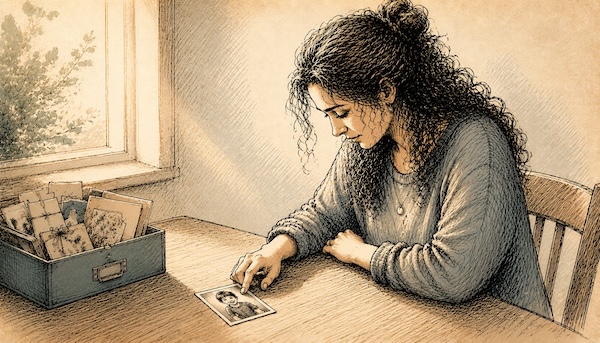
You found a photo. Maybe you were looking for it. Maybe it just surfaced — on your phone, in a box, in a drawer you’d stopped opening.
Your child, young. A face you recognize and don’t at the same time. And something passes through you — older and quieter than sadness, not quite love, not quite loss.
“That’s a different person,” you think.
And then, almost without meaning to: I never really knew them.
You put the photo down. Or you keep looking. Either way, something has shifted, and you’re not sure what to do with it.
If you’ve felt that — if an old image of your child stirs something you can’t quite place — this is for you.
Why This Grief Is So Hard to Name
There’s a version of this grief that gets talked about — the parent who mourns “the daughter they raised,” or “the son they thought they had.”
There is this idea: a name, a room, a version of a future, started forming from the first moment — it’s a girl, it’s a boy. It is very difficult to receive a new person and stay completely open and "unbuilt". We build. We just don’t always notice ourselves doing it.
But underneath that idea is something even larger, and it has nothing to do with being trans: there was always more of this person than you could ever see. No parent sees all of it. The idea was always going to fall short of the actual person standing in front of you.
Grieving the idea doesn't make you less affirming, and it doesn't mean you're rejecting your child. It means you noticed the gap before you closed it. Releasing the idea you'd been holding — choosing the person in front of you instead — is still something to grieve, even when it's the only choice you'd ever make.
It's recognizing how completely they were always their own — and how much of what you thought you knew belonged, quietly, to you instead of them.
What You’re Actually Looking At
The photo catches you because it’s doing something specific.
It’s showing you a before and an after in a single image. And in the gap between who your child looked like then and who they are now, you’re briefly aware of something that was always true — just less visible:
You didn’t know this person.
Even when they were small. Even when there was no separation between your life and theirs — their weight, their smell, their face you memorized, their habits you could predict. There was an interior life happening in there that you had no access to. A person becoming, in ways you couldn’t see.
The photo makes that visible. The gap between your child’s outside and their inside — the one that existed long before you knew it existed — suddenly has an image attached to it.
And that is disorienting in a way that’s hard to describe, because you love your child. Completely. And you’re still looking at that photo thinking: Who was that? Who did I think I was looking at?

Children Are Their Own People. We Just Forget That.
One of the stranger aspects of parenting is the illusion of knowing.
You knew their cry, their run, the specific way they laughed. You could finish their sentences. You knew which foods they’d refuse and which friends they’d call at 11pm. In so many real ways, you knew them.
And then something reveals itself — an identity, a truth they’d been carrying for years, sometimes a truth they didn’t even have words for yet — and you realize the person you knew was always more than what you had access to.
They come out of you, and they are immediately, irrevocably their own. They always were. The grief some parents feel is sometimes the grief of having that truth made undeniable.
You love someone you don’t fully know. That’s true of everyone you love, if you’re honest. But you don’t usually carry that awareness with your child the way you might with a partner or a close friend.
With your child, somehow, you assume you know everything. The illusion runs deepest right here.
There’s a deeper look at holding onto yourself while you do this here: → How to Support Your Transgender Child (Without Losing Yourself)

Why You Might Not Let Yourself Feel It
Affirming parents carry a pressure that doesn’t get acknowledged: to hold only the right emotions.
Love. Pride. Fierceness.
Those are safe to name. Those belong to the parent you’re trying to be — the one your child needs. And you feel all of those things, deeply, without question.
But there’s this other thing — the disorientation, the grief that doesn’t have a face to put on it, the feeling that catches you off guard in the car — and you push it down. Because saying it out loud feels dangerous. Because you don’t want to look like you’re struggling with acceptance.
What you’re actually carrying is something more human than that: the awareness that your child is their own person, with an interior life you’ll never fully reach, living out a truth that was always theirs.
That is both beautiful and quietly hard, at the same time, without contradiction.
A parent I’ve worked with said it this way: “I’m looking at a picture of someone I never knew. Really.”
She wasn’t rejecting her child. She was meeting the strangeness of love, straight on.
If carrying everything alone has started to feel like the whole job, there’s more on that here:
→ Why Parenting Feels Harder Than It Used To

You Don’t Have to Resolve This
Grief doesn’t always need to go somewhere.
Sometimes it’s just the ache of loving someone across a gap you can’t close — and recognizing that the gap was always there, even in the years when you didn’t know it existed.
You don’t have to do anything with the photo. You don’t have to stop feeling what you feel when you look at it. You don’t have to turn it into a lesson or evidence of how far you’ve come.
Some things are just true and heavy and worth sitting with for a minute.
Your child is their own person. They always were. You love them — the whole of them, the parts you know and the parts you’ll never reach.
Some days, that love comes with a grief that won’t sit still long enough to explain itself. That’s the size of what you’re loving.
Visual Transparency: All images in this article were generated via DALL-E to illustrate the concepts discussed.