
How to Support Your Transgender Child (Without Losing Yourself)
Finding out your child is transgender or nonbinary can feel like the ground shifts slightly under your feet.
You love them. That part is solid. But suddenly there are new words, new fears, new questions.
Most advice about supporting a transgender child focuses on the visible things — names, pronouns, clothes.
Those matter.
But real support doesn’t begin with what you say.
It begins with how you show up.
Not perfect. Not fearless. Just steady enough.
This isn’t about getting everything right immediately. To be the anchor your child needs, you have to find your own solid ground first.
Let’s talk about what that actually means.
A note on scope: there's a lot to navigate when your child comes out — schools, medical decisions, legal protections, community resources. Those things matter, and I'll be covering them in a dedicated resource guide. But good information is hard to use when you're not steady inside. That's what this post is about.
What Supporting Your Transgender Child Really Means
Support is often confused with certainty.
It’s not certainty.
It’s presence.
Your child does not need you to have all the answers about gender. They need to feel that home is not the place where they have to defend who they are.
Support means:
They don’t have to brace before speaking.
They don’t have to measure your reaction.
They don’t have to take care of your emotions before they can share their own.
You won’t always understand everything right away.
That’s okay.
Understanding can grow.
What matters first is this quiet message:
“I’m here. I’m not turning away.”
Consistency Matters More Than Perfection
You will probably use the wrong pronoun at some point.
You may feel grief for the future you once imagined.
You might have moments of doubt that surprise you.
None of that disqualifies you from being a loving parent.
What builds trust isn’t flawlessness.
It’s repair.
A simple:
“Thank you for correcting me.”
And moving on.
A calm, imperfect parent feels safer than a tense parent trying to say everything exactly right.
Your child doesn’t need a performance.
They need you to stay.
This is an ongoing journey, not a single brave talk where everything is "settled."
It is a series of small, daily affirmations and interactions that signal to your child:
I am here, I am steady, and I’m not going anywhere.
This is a relationship, not an event. And within your relationship you grow alongside your child.
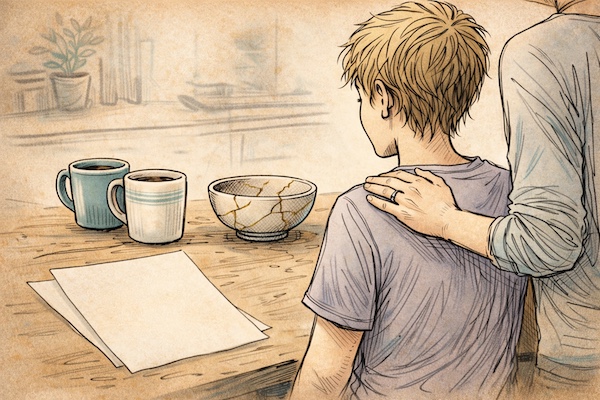
Before Anything Else: Steady Yourself
When your child shares something vulnerable, your body may react before your mind does.
A tight chest.
A rush of fear.
An urge to ask a hundred questions.
That reaction doesn’t mean you’re unsupportive.
It means you care.
But if fear drives the conversation, your child will feel it.
Your child can feel you.
Not because they’re psychic.
Because they know you.
They know the difference between your relaxed voice and your tight one.
They know when your “I’m fine” isn’t fine.
And many kids will quietly start protecting their parents — softening their truth, holding things back, pretending they’re less certain than they are.
Not because they want to.
Because they love you.

So before you respond, pause.
Three seconds is enough.
Let your shoulders drop.
Let your voice slow down.
You don’t have to solve the future at this moment.
You only have to respond to the person in front of you.
You can say:
“Thank you for telling me.”
“I’m really glad you shared this.”
“I want to understand.”
Clarity can come later.
Connection comes first.
The Quiet Ways Anxiety Shows Up
Fear rarely arrives screaming.
More often it looks like:
Too many “Are you sure?” questions.
Late-night internet spirals.
A slightly sharp tone you didn’t intend.
Going quiet because you’re overwhelmed.
Even loving concern can feel like doubt to a child who is already unsure how the world will treat them.
Your worry makes sense.
The world can be loud and unkind.
But inside your home, your child should not feel like a debate topic.
They should feel like your child.

And if fear is leaking into your tone, you may find insight in: how not to project fear onto your child.
The Layers of Real Support
Think of support less as a checklist and more as daily life.
1. Home feels calm
You don’t need to throw a parade every Tuesday.
But you also don’t want your living room to feel like a courtroom.
Your home should not feel tense when gender comes up.
Private reassurance matters:
“My love for you is not up for discussion.”
Children relax when they know they don’t have to earn belonging.
Your child should not feel responsible for managing your distress.

2. Everyday Respect
Using your child’s chosen name and pronouns is not political.
It’s relational.
It’s how we show basic respect to any human being.
If it feels awkward at first, practice.
Quietly.
Patiently.
It becomes easier.
What feels big in your mouth now will eventually feel natural.
Consistency is what builds safety.
3. Hard Moments
There will be days when your child is discouraged.
Or angry.
Or tired of explaining themselves.
Your instinct might be to fix it.
To find the silver lining, make a plan, say something that helps.
That instinct comes from love.
But sitting with someone in their pain — without rushing to resolve it — is one of the hardest things a parent can do. We're not really taught how.
And it can feel uncomfortably like doing nothing, when actually it's everything.
Sometimes the most powerful response is simpler than it feels:
"I can see this is hard. I'm right here."
Not a solution. Just solidarity.
And when you make mistakes — because you will — those moments aren’t proof you’re failing.
They’re opportunities to show your child what repair looks like.
That’s a gift too.
4. Navigating Family and Social Pressure
Grandparents may resist.
Schools may misunderstand.
Friends may say clumsy things.
And sometimes the hardest part isn't out there — it's inside your own home.
Some partners need more time. They're not cruel. They're not indifferent.
They're moving through their own process, and it's slower.
That can feel isolating when you're already carrying so much.
You're allowed to feel that.
You're also allowed to gently hold the line — not as an ultimatum, but as a quiet, steady message: our child needs to feel safe here, and that can't wait.
And sometimes it's harder than that. Sometimes a family member — or a co-parent — isn't slow. They're opposed. That's a different kind of pain, and it deserves to be named. You may not be able to change them. What you can do is control the atmosphere your child lives in, and limit their exposure to relationships that ask them to shrink.
For everyone else — the grandparent who keeps getting it wrong, the school that isn't cooperating — one conversation is rarely enough. You may need to have the same conversation more than once, calmly, without apology. That's not failure. That's what protection actually looks like most of the time.
Your child should not become the battleground for adult discomfort.
Sometimes support means having conversations away from your child’s ears.
Sometimes it means saying:
“We are supporting them in this. I need you to respect that.”
Calm. Clear. Not defensive.
Protection doesn’t have to be loud to be strong.
5. Your Own Stability
You are allowed to have needs.
You are allowed to feel overwhelmed.
You are allowed to step away from the news.
You are allowed to laugh about something completely unrelated to gender.
Your child benefits from a parent who has a life that isn’t entirely made of vigilance.
Taking care of yourself is not selfish.
It is structural.
When you feel steadier, your home feels steadier.
Supporting a Nonbinary Child
If your child identifies as nonbinary, the core remains the same.
Respect. Presence. Consistency.
But it can feel harder to grasp — and that's worth acknowledging.
With a transgender child, there's often a familiar narrative to hold onto. With nonbinary, parents sometimes find themselves asking: but what does that mean exactly?
And their child may not have a neat answer either. Some nonbinary kids are still finding their own language for it.
One child put it this way: "Everyone else seems to know who they are. That's supposed to be the easy part. And I just don't know."
That not-knowing is not a phase to fix. It's a valid place to be.
What makes it genuinely complex is that your child is navigating an identity that the wider world doesn't always have space for. They may move through school, family gatherings, and public life in a world that still sorts people into two categories — and that friction is real, even when home is safe.
Your job isn't to resolve that tension for them. It's to make sure they don't have to face it alone.
You don't need to fully understand nonbinary to honor it. You don't need to interrogate. What helps most is resisting the urge to rush their identity into a cleaner box — including a new one. Allow space for things to unfold. Stay curious without pressure.
Sometimes the most powerful thing a parent can offer is simply a home where their child doesn't have to explain or justify who they are.

Common Questions Parents Have
How do I know if I’m doing this right?
If your child still talks to you — even if they’re moody or frustrated — that connection matters more than perfect language.
What if I’m still learning?
You can say, “I’m still learning about this, and I’m committed to being on your team.”
You don’t need a degree in gender theory to love your child well.
What if I feel overwhelmed by the political climate?
It’s okay to limit your exposure.
Your primary responsibility is the atmosphere inside your home.
A calm kitchen table matters more than winning arguments online.
You Don’t Have to Do This Perfectly
Your child does not need a flawless parent.
They need a parent who stays.
Who softens when necessary.
Who repairs when needed.
Who keeps showing up.
Steadiness is not something you either have or don’t have.
It’s something you practice.
One pause.
One calmer response.
One honest conversation at a time.
When you stay grounded, you give your child the space to grow, explore, and simply be.
Take a Moment for Yourself
If your feet feel slightly unsteady right now, that makes sense.
You love your child.
Of course this matters.
If you need a few minutes to settle and come back to yourself, I’ve created a gentle audio that helps you move from panic to steadiness.
Not to fix you.
Just to help you breathe again.
Download the Peaceful Warrior Calm Audio
Because supporting your child shouldn’t require you to disappear.
You’re allowed to be steady.
And human.
Visual Transparency: All images in this article were generated via DALL-E to illustrate the concepts discussed.