Holding Fear for Your Child Without Passing It Down
There’s a particular kind of fear many parents carry.
It doesn’t shout.
It doesn’t spiral.
It doesn’t look like panic.
It sits in the quiet.
In the background hum of an otherwise ordinary day.
In the way your eyes linger just a moment longer.
In the mental rehearsals of “what if,” even when everything seems okay.
This is not the fear of emergencies.
It’s the fear of responsibility.
The kind that says, “I’ll carry this, so they don’t have to.”
And maybe you have.
This article isn’t about how to get rid of that fear.
It’s not a guide to “managing” it, either.
It’s about something quieter: how that fear can live inside you — without spilling into them.
The Invisible Weight You’ve Been Holding
This fear doesn’t announce itself.
It doesn’t throw tantrums or knock things over.
It blends into the rhythm of your day.
It’s the extra check before you send them out the door.
The slight pause before answering a question.
The way your body tightens at the thought of school, strangers, systems.
And because it’s subtle, it often goes unseen — even by you.
But just because it is quiet doesn’t mean it’s light.
Fear, when carried alone, can become heavy in ways that don’t have words.
Not because it’s too much.
But because no one else is holding it with you.

Fear Isn’t Dysfunction. It’s Devotion.
Let’s name something clearly here:
The presence of fear doesn’t mean something’s wrong with you.
It doesn’t mean you’re overreacting.
It doesn’t mean you’re doing parenting wrong.
Fear is often what love looks like when it takes responsibility seriously.
It’s your care. Your alertness.
Your quiet hope wrapped in realism.
It’s the part of you that stays awake — not to panic, but to protect.
Not to fix, but to be ready.
When fear is framed this way, it loses its shame.
It becomes something tender.
Not something to hide.
If that fear has started to make connection feel harder, Staying Present With Your Child Under Stress explores how to stay close—even when the tension stays with you.
Why Unspoken Fear Builds Pressure
Fear becomes heavy when it has no place to go.
It doesn’t need to be fixed. But it does need to be held — somewhere.
Because when it’s unspoken, it starts to harden.
When it has no witness, it grows denser.
When there’s no context, it can feel like you’re the only one who sees the storm coming.
And maybe you are.
But even weather watchers need shelter.
Even strong parents need somewhere to let the weight rest for a while.
This isn’t about unraveling.
It’s about refusing to carry everything in silence.
Remember:
Fear is information, not a prediction.
It points to what matters.
It does not dictate what will happen.
Naming fear does not strengthen it.
Suppressing it does not dissolve it.

How Fear Unintentionally Transfers
Here’s the hard part:
Fear doesn’t usually transfer through lectures.
It transfers through tone. Atmosphere. Absence.
It passes in the narrowing of attention.
The subtle urgency in daily routines.
The shift from curious presence to tight focus.
Not because you’re doing anything wrong — but because unheld fear moves.
It looks for a landing place.
And children, even without understanding it, feel it.
Not always in what you say.
But in what stays unspoken.
What Keeps Fear Contained — And In Your Care
Containment doesn’t mean hiding.
It means placing.
Fear stays with you (instead of passing through them) when:
You let it exist internally without handing it over relationally
You name it somewhere, even if not out loud
You have other adults who can witness it — even briefly
You remember that your child doesn’t need to carry what belongs to you
You don’t have to pretend you’re fearless.
You can be honest about the world without collapsing into dread.
You can hold awareness with compassion instead of urgency.
What Strength Actually Looks Like
Your child doesn’t need you to be unshakable.
They need to know that when you are shaken, you don’t disappear.
Strength isn’t about being unaffected.
It’s about being real — and still reachable.
You can feel afraid… and still be a steady presence.
You can carry the weight… and still offer warmth.
Fear doesn’t cancel out connection.
In fact, when held well, it deepens it.
When Fear Creates Space Instead of Strain
Something softens when fear is allowed to exist without pressure to resolve.
When you stop telling it to go away — and just let it be heard, even quietly.
Sometimes, that’s all it takes for the inner volume to lower.
Not because the world changed.
Not because you found new courage.
But because fear was no longer bracing against silence.
That’s what creates space.
Not certainty.
Not resolution.
Just a little more breath.

Before You Go
If you’ve been holding this fear quietly, you’re not alone.
It doesn’t make you weak.
It doesn’t make you anxious.
It makes you attuned.
And attunement — when paired with support — is a form of fierce love.
You’re allowed to carry this fear.
You’re allowed to let it soften.
You’re allowed to protect your child without transferring your tension into their world.
And you’re allowed to receive support for yourself, not just them.
This article sits between emotion and boundary.
If what you’re holding has started to feel like too much, Parenting When Everything Feels Overwhelming might offer a place to rest inside that knowing.
You don’t have to be fearless.
You just have to be here.
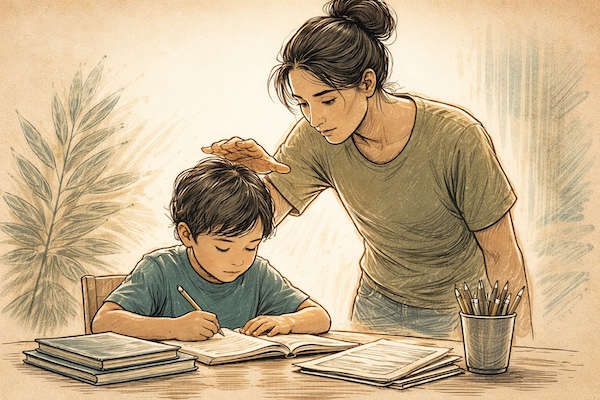
Visual Transparency: All images in this article were generated via DALL-E to illustrate the concepts discussed.