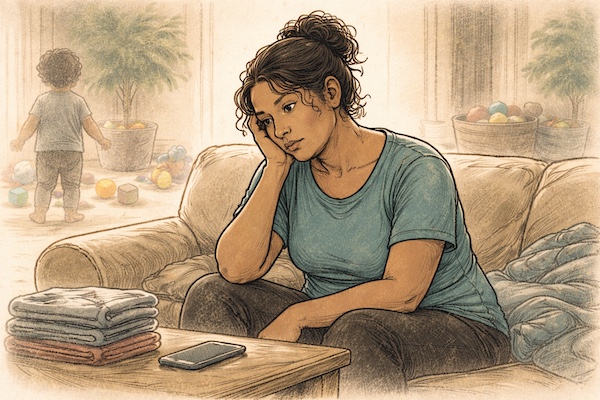
Why Parenting Feels Harder Than It Used To
A Quiet Truth Many Parents Are Just Now Finding Words For
1. Naming the shared, unspoken experience
You might not say it out loud, but something’s been tugging at you lately.
Parenting hasn’t changed that much.
And yet—
It feels heavier. Like every part of the day takes just a little more from you than it used to.
You may catch yourself wondering:
“Why does this feel so hard?”
“I used to manage this without unraveling.”
“Nothing major happened… so why does it feel like something did?”
There’s no single crisis to point to. No specific before and after. Just this slow, accumulating sense that what once felt doable now feels dense. Stickier. More exhausting.
If that sounds familiar, I want to say something clearly:
You’re not doing something wrong.
But something has changed.

2. The quiet blame game we play with ourselves
When life feels harder than it “should,” our minds start scanning for internal flaws.
Maybe you’ve caught yourself thinking:
“I’ve become less patient.”
“Other parents seem to be holding it together.”
“I should be more grateful. More grounded. More… something.”
These thoughts feel reasonable. Sensible, even.
But they’re not necessarily true.
In fact, they’re some of the most common—and most misleading—narratives parents absorb. Especially when they’re moving through invisible strain.
So if you've been telling yourself a quiet story of personal failure... this might be the part where your shoulders get to drop just a little.
There’s another explanation. A truer one. And it doesn’t involve self-blame.
3. The missing word that changes everything
The word most parents are never taught to use when things feel like this?
Capacity.
Not motivation.
Not love.
Not resilience.
Capacity is the inner space you have to show up, respond, tolerate, attune.
It’s the breath between stimulus and reaction. The stretch of patience that lets you stay present instead of snapping.
And here’s the thing about capacity: it isn’t fixed.
It isn’t infinite.
And it definitely doesn’t reflect your worth.
It’s affected by what you’re carrying — even when you’ve stopped noticing the weight.
For more on how this invisible load builds—and how to name it—read Parenting When Everything Feels Overwhelming.
4. How slow stress chips away at your margin
Not all stress is loud.
Some of it is low-volume, always-on.
You might not name it as stress because it’s just... there.
The unfinished to-do list.
The constant mental scan for what’s next.
The unspoken worry that lives in the background, even on “good” days.
This kind of stress doesn’t shout.
It accumulates.
And over time, it starts to show up in ways that feel personal:
You snap faster than you used to.
Decisions feel harder, even small ones.
You go emotionally flat—or erupt over something minor.
This isn’t about parenting becoming too hard.
It’s about your margin shrinking.
And it makes perfect sense.

5. Why parenting is the first place it shows
Some parts of life can run on autopilot.
Parenting isn’t one of them.
It calls on your deepest capacities:
Presence. Flexibility. Emotional availability.
So when those capacities get squeezed, parenting is where the strain shows up first.
Not because you’re doing it wrong.
But because you’re doing it with your whole heart.
Parenting doesn’t create the exhaustion.
It reveals it.

6. A specific note for parents of trans & nonbinary kids
If you’re parenting a trans or nonbinary child, there’s a good chance you’re carrying extra weight most people can’t see:
Hyper-awareness in public spaces
(For a deeper look at why the 'Invisible Audience' feels so heavy in these spaces, see my piece on Why You Feel Watched Around Other Parents)Worry that flickers even on ordinary days
The mental load of advocacy, protection, preparation
This isn’t about a lack of love.
It’s not because you're not “cut out” for this.
In fact, it’s your love that makes you vigilant.
It’s your commitment that creates this invisible layer of pressure.
That’s not weakness. It’s reality.
And it doesn’t mean you need to try harder — it means you deserve more room to breathe.

7. There is no moral in this story
This is the most important part.
If you hear nothing else, let this land.
What you’re experiencing is not:
A failure of character
A sign you’ve become less capable
A reflection of how much you love your child
There is no shame in being impacted by what you carry.
There is no moral meaning in having less capacity.
Load affects capacity. That’s it.
When that gets named, something inside often softens.
As if, finally, you don’t have to argue with yourself anymore.
8. A gentle pause before anything else
Knowing this doesn’t solve everything.
But it changes the texture of your day.
You don’t have to keep bracing.
You don’t have to push through.
You don’t need a solution this minute.
Sometimes, the most regulating thing is just being able to say:
“Oh. That’s what this is.”
Let this be a pause.
A soft exhale.
A moment that doesn’t demand more of you.
You’re allowed to rest inside that knowing.

9. If You Want To Keep Reading
If this offered some clarity or calm, you may find your next right step here:
Staying Present With Your Child Under Stress
You’re allowed to land here first.