Why You Feel Watched Around Other Parents (Even When No One’s Looking)
The quiet tension that shows up before anything actually happens
We often talk about parenting as a series of tasks, but for many of us,
it is a series of environments.
There is the environment of your living room, where you are often capable, attuned, and flexible.
Then, there is the environment of the school pickup line, the birthday party, or the local playground.
In those spaces, something shifts.
You might notice your shoulders move toward your ears.
You might find yourself correcting your child’s behavior more quickly than you do at home.
You might leave a perfectly "fine" social interaction feeling as exhausted as if your body ran a race your brain didn’t sign up for.
If you have ever wondered why you feel so on edge even when no one is being unkind,
it’s important to know:
you aren’t imagining the tension, and you aren’t "bad" at being social.
The Tension That Shows Up Before Anything Goes Wrong
When we feel anxious around other parents, we often look for a "reason."
We scan the environment for a rude comment or a judgmental look.
When we don't find one, we turn that scan inward and assume the problem is us.
It’s Not About What They Say — It’s About What Your Body Anticipates
The body doesn't wait for a critique to begin defending itself.
Family pressure and social pressure often land in our history, not just the present moment.
Your system is designed to keep you safe, loved, and included.
Because of this, it often treats a public space like a high-stakes performance before a single word is even spoken.
Why Parenting Around Other Parents Feels Different From Being Alone
There is a fundamental shift that happens when parenting moves from a private act to a public one.
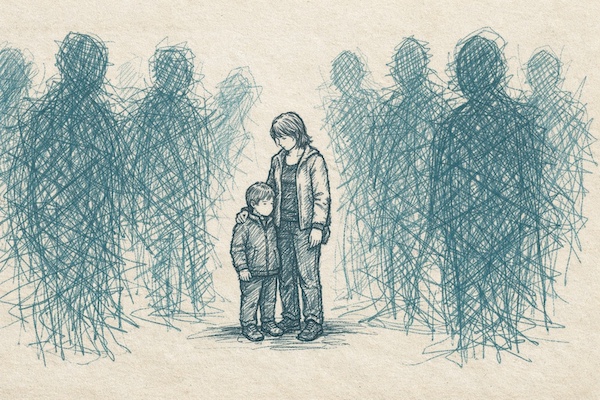
I call this the Invisible Audience — the pervasive sense of being measured and evaluated while you are trying to do the hardest job in the world.
And if you're parenting a child the world doesn't always make space for,
that tension can feel especially relentless — because sometimes, it is.
Parenting Becomes Performative in Group Settings
When we are alone, we parent for relationship — focusing on connection and emotional regulation.
But the moment another adult enters the frame, the Invisible Third Parent grows louder.
We subconsciously shift toward parenting for behavior,
worried that a tantrum or a messy face will be seen as evidence that our way "isn't working".
Comparison Happens Faster Than Conscious Thought
Even in a room full of friends, your brain is running a background program of micro-comparisons.
You aren't doing this because you are judgmental;
you are doing it because your body is trying to map out the "social temperature" of the room.
The Invisible Social Scan You’re Running
If you feel your heart rate spike at a playground, it’s because you’re performing a Social Scan.
It is checking for cues of belonging.
Your System Is Checking for Belonging, Not Approval
It’s not approval your body craves — it’s connection.
The kind that once meant survival.
When you are around other parents, your body is checking to see if you are "safe" within the group.
That vigilance costs you energy, draining the capacity you need to actually be present with your child.
Why School Pickups, Playgrounds, and Parties Are Common Triggers
These environments are sensory and social minefields.
Between the noise, the sheer number of bodies, and the unspoken "rules" of the space,
your battery depletes much faster than it does at home.

Why This Tension Can Exist Even When No One Is Judging You
One of the most frustrating parts of this tension is that it can exist in a vacuum of actual criticism.
Anticipation Activates the Same Circuits as Actual Criticism
Your body remembers old roles and old attachment patterns. If you grew up in an environment where you needed to be "good" or "quiet" to be safe, your body will react to the possibility of judgment as if it is a current threat.
Silence Can Feel Louder Than Comments
Sometimes the hardest pressure isn’t what’s said — it’s what hovers unspoken. A glance that feels sharp. A stillness that feels expectant. The kind of quiet that makes your body brace.
Because there is nothing concrete to respond to, your body stays in a state of high alert, scanning for the "danger" it feels but cannot see.
This Is Not a Confidence Problem (And You’re Not “Too Sensitive”)
The standard advice for this feeling is often to "just stop caring what people think."
But if this reaction is biological — a perceived threat to connection — then you cannot simply "think" your way out of it.

Why “Stop Caring What Others Think” Doesn’t Work Here
Telling a parent to stop caring about social feedback is like telling a person to stop having a startle reflex.
Your body is doing exactly what it was evolved to do:
protect you from isolation.
Regulation ≠ Toughening Up
Finding steadiness isn't about becoming "tougher" or more indifferent.
It’s about recognizing when your capacity has shrunk because of the weight of expectations.
When This Tension Stacks on Top of Everything Else You’re Carrying
This social tension doesn't exist in isolation.
It sits on top of the everyday emotional weight you are already carrying.
Social Pressure Draws From the Same Limited Capacity Pool
Every child and adult has a limit to how much stimulation and pressure they can handle.
When you add the Invisible Audience to the mix, you run out of capacity much sooner.
This is why you might feel capable and attuned at 10:00 AM at home,
but feel your patience snap at a 2:00 PM birthday party.
This isn't a failure of character; it's a simple matter of capacity. To understand how this invisible load builds over time, read Why Parenting Feels Harder Than It Used To.
Sometimes it works the opposite way.
You hold yourself together beautifully in public — smiling through the playground tension, staying calm through the birthday party chaos —
only to walk through your front door and feel everything unravel.
You snap at your child over something small.
You feel irritable, depleted, unrecognizable to yourself.
This isn't because you "saved your worst" for home.
It's because home is the first place your body trusts enough to let go.
Just like children who "behave" all day at school
and then melt down the moment they see you,
adults do this too.
We perform regulation in public, then collapse in private —
not because we're failing, but because we've been working so hard to hold it together.

How This Connects to the Broader Emotional Load of Parenting
Understanding that this tension is a form of "noise" helps you see the bigger picture.
Whether the pressure is coming from strangers at the park or from within your own family,
the impact on your body is the same.
For a deeper look at how to navigate these pressures when they come from those closest to you, you can explore my guide on Parenting through the Noise: Navigating Family Pressure.
Naming It Is Often the First Moment of Relief
The goal of naming this tension isn't to "fix" it immediately.
It’s to change the way you talk to yourself about it.
When You Stop Asking “What’s Wrong With Me”
When we name the weight, we can finally begin to set it down.
You stop asking why you are "so reactive" and start asking,
"What part of me is trying to stay safe right now?"
And Start Noticing What Your Body Is Responding To
The next time you feel that familiar squeeze in your chest at a school event,
try to notice it without judgment.
Your body is simply trying to navigate the Invisible Audience.
You don't need the approval of every parent at the park to be a good parent.
The only relationship that truly needs to be protected
is the one between you and the child in front of you.
Everything else is just noise.

So when your shoulders rise at the playground,
or your voice gets tight during a parent-teacher meeting,
you don’t have to power through it or pretend it’s not there.
That tension is real — but so is your ability to meet it with grace.
You don’t need every parent to see your worth.
Just you, seeing your child.
And seeing yourself, too.
Visual Transparency: All images in this article were generated via DALL-E to illustrate the concepts discussed.