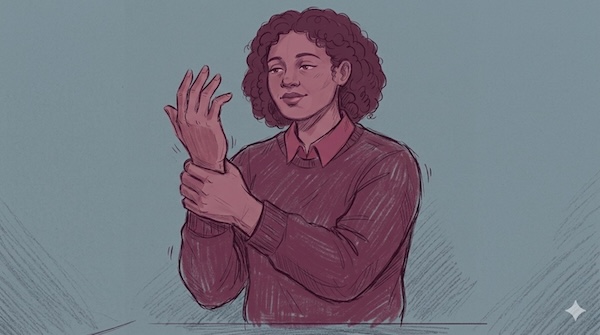
What to Do the Moment a Headline Breaks You
A tapping method for parents who need to get back to themselves — fast.
Quick summary: Another headline. Another vote, another policy, another thing that makes the world feel less safe for your child. If you’ve ever wondered how to calm down after distressing news — not push it down, but actually move through it — this post is for that exact moment. It introduces a six-step tapping method that I learned from hypnotist Mike Mandel, who has refined it from a lineage that includes traditional EFT and Faster EFT: a physical tool you can use on the spot, before the feeling follows you into the rest of your day.
You weren't even looking for news. You were checking a message, or waiting for coffee to brew, or just scrolling for half a second.
And then there it was.
A vote. A law moving through a legislature. A rights rollback. Maybe in a state or a country that isn't even yours. Maybe it is.
Your jaw tightens. Your chest does something. Your body reacts before you’ve even finished reading.
And underneath all the thoughts that rush in after — What does this mean? What comes next? — there’s usually something quieter and heavier:
Is my kid safe?
The threat is real. And you don't need to calm down — you need somewhere to put what just happened in your body, so it doesn’t follow you into everything else.
That’s what this is for.
What's Actually Happening When a Headline Hits
When you take in something frightening — especially something about your child’s safety — your body moves into high alert fast.
It’s wiring, not weakness. Your body is doing exactly what it was built to do.
But this isn’t the kind of threat you can solve in the next five minutes. So your body stays activated with nowhere for that energy to go. This is what happens when your capacity — the internal space you have to respond rather than react — gets used up faster than it can recover. There’s more on that in Why Parenting Feels Harder Than It Used To.
What you feel might be rage. Or a heavy kind of dread. Or frantic spinning — opening more tabs, reading more, looking for something that will make it make sense. Or maybe you go flat and cold, and you're not sure which is worse.
If headlines hit you harder than they used to, that doesn’t mean you’re weak. It means your child matters to you.
Tapping gives your body somewhere to put that activation.
The Six-Step Tapping Method for Overwhelm
This method comes out of a lineage of tapping approaches — from traditional EFT to Faster EFT — refined over time by various practitioners. I learned this version from hypnotherapist and NLP trainer Mike Mandel. I use it personally and in my own practice because it’s simple, physical, and holds up under real stress.
The idea is simple: tapping specific points on the body while you’re still in the feeling — not after you’ve pushed it down — helps the charge move through instead of staying lodged in your body all day.
You don’t have to fully believe in it to try it.
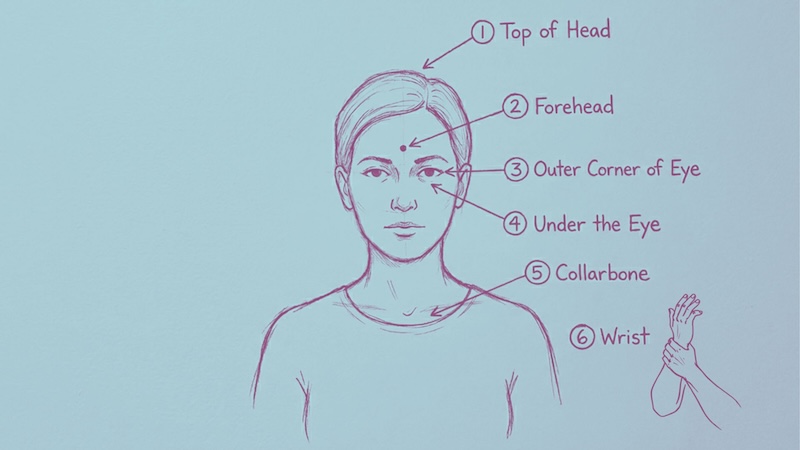
The six points:
Top of the head — the center of your crown
Forehead — just above and between your eyebrows
Outer corner of the eye — the bony edge, not the eye itself
Under the eye — the ridge just below
Collarbone — just below where your collarbones meet, slightly to one side
Wrist — squeeze the wrist of either hand and take a deep breath
How to do it
For the top of the head, use your whole palm flat against the crown. For the forehead point between the brows, hold your hand vertically — fingers pointing down — so all your fingers land in a line down the center of your forehead. For all other points, use all your fingers with your hand horizontal, as you normally would.
Tap firmly but not hard — about the pressure you’d use to knock on a door. Either side of the body works.
Start at the top of the head. Tap each point 7–10 times, then move to the next. Don’t rush, and don’t worry about counting exactly. The rhythm matters more than precision.
While you tap, stay with the feeling. Name it if you can — this fear, this rage, this heaviness.
You’re not trying to talk yourself out of it. You’re letting your body finish a stress response that got interrupted.
When you reach the wrist, stop tapping. Squeeze the wrist of either hand and hold it. Take a deep breath in — and a longer exhale out. If something wants to come with the exhale — “I let that go,” “peace,” or just a word that feels right — let it. If nothing comes, that’s fine too. The breath is what matters.
That’s one round. If there’s still charge, start again from the top. Most of the time, one to three rounds is enough — and the results are often faster and more complete than you’d expect. The feeling doesn’t just quiet down. It’s gone, or close to it.
Why You Need to Be in It When You Tap
You need to be in the feeling when you tap. Actually feeling it — not thinking about it from a calm place.
This is harder than it sounds, and there’s a reason. When an emotion is strong, the thinking part of your brain goes quiet. That’s not a flaw — it’s how we’re wired. The more activated you are emotionally, the less capacity you have to think your way out. Which means in the middle of it, you may not remember that tapping exists.
With practice, that changes. You start to recognize the state while you’re in it and reach for this automatically. But in the beginning, it often works the other way: the moment passes, you calm down, and then you remember.
That’s still fine — with one condition. When you come back to it later, don’t do it from neutral. Bring the memory back as vividly as you can. Don’t be afraid to dial it up as high as it goes — as close to how it actually felt as you can get. Then tap. It only moves through when it’s activated. A low-level memory of a feeling won’t shift much. The real thing will.
You know how sometimes something small sets you off completely? Someone cuts you off in traffic. A politician says something that lands like a punch. And even days later, the moment you think about it or tell someone about it, you’re right back there — chest tight, jaw clenched, zero to a hundred in a second.
That’s an emotion that never finished moving through. It’s still in your system, still loaded, just waiting for the right trigger to fire again.
Every time it fires, you’re the one struggling. They said the thing once. Your body keeps replaying it on a loop. Tapping it out when it’s activated — really activated — is how you take that power back.
You still care about your child, your community, what’s at stake. But the emotional charge around that specific thing — that politician, that comment, that law — flattens out. You can recall it, think about it clearly, talk about it without your body bracing. It just doesn’t hijack you anymore. That’s not indifference. That’s being free enough to respond instead of just react.
What Happens After Distressing News Moves Through You
The headline is still there. The law didn’t change.
And you feel different.
That’s the thing about tapping that surprises people: the situation doesn’t improve — and the charge lifts anyway. You can think about it, talk about it, scroll past it again — and your body doesn’t go back to that state. What was hijacking you becomes something you can look at without bracing.
You can breathe without it catching. You can be in the room with your kid without the fear leaking through everything you say and do.
That’s not small.

This isn’t about pretending things are okay when they aren’t. It’s about helping your body come back enough that you can think again, respond again, and stay present for what actually needs you. If you want to understand what that state of constant bracing costs — and what it looks like to start loosening it — What It Means to Stop Bracing goes deeper.
A Note on This Method
Tapping shows up in many forms and under different names. Mike Mandel’s Six-Step Method is the one I use personally and in my own practice because it’s simple, physical, and holds up under real stress.
I’m sharing it here with full credit to him.
(A video walkthrough of this method is coming — I’ll add it here when it’s recorded. For now, the steps above are enough to get started.)
One round of tapping, and what was lodged in your chest has somewhere to go.
Try it once. Notice what moves.
PS — If you tried this and want to talk through what happened, just reach out. I’m here.
Visual Transparency: All images in this article were generated via Gemini to illustrate the concepts discussed.