
What It Means to Stop Bracing
You're not wired this way. You were trained this way.
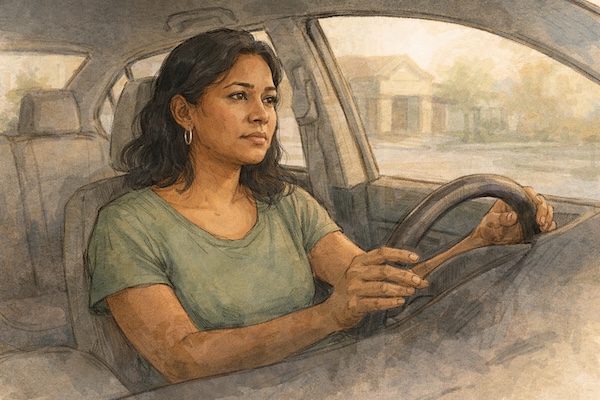
You've been holding your shoulders a certain way for a while now. Maybe you noticed it once — in the car, waiting for your child to come out of school. The way your jaw tightens before you've even seen their face. The quick scan: how did it go today? Are they okay? Did anything happen?
And then they get in the car and say "fine" and you exhale — but only halfway.
That halfway exhale. That's what I want to talk about.
A lot of parents of transgender and nonbinary children describe something like this: a low, persistent readiness. Always slightly on. Always monitoring the temperature of a room, a conversation, a look from a stranger. It doesn't feel dramatic. It just feels like being a responsible parent in a world that doesn't always make it easy to be one.
The problem is that over time, that readiness stops feeling like a choice.
It starts feeling like you.
In this post
Why It Made Sense — And What It Costs
What the Information Flood Does to a Body
What Bracing Actually Is
Bracing is the body's way of preparing for impact. You do it before a hard conversation. Before a school meeting where you're not sure how the teacher sees your child. Before a family dinner where someone might say something.
It's useful in those moments. The problem is when it stays.
When bracing becomes the default, you stop choosing it. Your body just does it — in the grocery store, during a quiet evening, even when your child is laughing in the next room. The perceived threat doesn't have to be present. The posture remains.
Parents living with this often describe it the same way: I don't know how to relax anymore. Even when things are good, I'm waiting for the other shoe to drop.
That's not a character flaw. It's a body that learned to stay ready — and never got the signal that it was okay to stand down.
Why It Made Sense — And What It Costs
Staying braced made sense. In a world that isn't always safe for families like yours, vigilance has a logic to it. If you stay prepared, maybe you won't be caught off guard. If you stay alert, maybe you can protect your child from the comment, the look, the system that wasn't built with them in mind.
And some of that vigilance came from real experience. Real moments that earned it. A comment at a family dinner. A teacher who got it wrong. A stranger's look that lasted a second too long. For some of you, much more than that — open hostility, institutions that failed your child, moments that left a mark that doesn't just disappear because time passed. Your body learned from those moments. It filed them away and said: stay ready.
But vigilance has a cost — and it accumulates quietly. The small moments of connection you were too tight to fully receive. The evenings that should have been rest but weren't. The version of yourself that existed before you learned to hold this much.

If this is the part that’s hitting hardest, this might help:
→ Why Parenting Feels Harder Than It Used To
What the Information Flood Does to a Body
Here's something worth naming separately, because it's easy to miss.
Some of what keeps parents braced isn't lived experience. It's the steady diet of worst-case stories — from the news, from online communities, from other parents who are also braced and sharing what they fear. All of it well-intentioned. All of it real, somewhere, for someone.
I’ve noticed this in myself: I could walk into a school meeting with a teacher I’d never met and already feel the tightness. Not because of anything she’d done. Because of a story I’d read the week before, about a teacher somewhere else, in a school I’d never been to. My body couldn’t tell the difference. It just knew: this is one of those rooms.
That’s what a steady feed of worst-case content does over time. You arrive at a birthday party already holding your breath. You read a neighbor’s distracted glance as hostility. You prepare for a conversation that turns out to be completely fine — and drive home in that strange, deflated relief.
The world gave you real reasons to be careful. The feed gave you reasons to be afraid of rooms you've never entered.
Those are different things — and it's worth knowing which one is actually in front of you.

There’s a whole piece on this if you need it:
→ Don’t Assume They Don’t Like My Child
What Stopping Doesn't Mean
This is where I want to be careful, because I've seen the fear that lives inside this question.
If I stop bracing, am I being naive? If I relax, am I failing my child? If I let my guard down, what happens then?
Stopping doesn't mean becoming indifferent. It doesn't mean pretending the world is safer than it is. It doesn't mean your advocacy stops or your attention disappears.
Steadiness and vigilance are not the same thing. A parent who is braced is reactive — she responds to threat because her body is already activated. A parent who is steady chooses when to engage. She responds from clarity, not from the accumulated tension of a hundred previous moments.
Your child doesn't need you perpetually armed. They need you present. Those are different things, and only one of them is actually available when you're braced.
And here's the part that's harder to hear: children are remarkably good at reading the room. When you enter a space already tense, already scanning, they feel it — and they start scanning too. Your vigilance, however loving its intention, becomes the lesson.
Over time, they learn to see the world through the same lens you've been using. Not because you told them to. Because you showed them how.
The steadier you are, the wider the world gets to be for them.
Worth reading alongside this one:
→ Staying Present With Your Child Under Stress
What It Actually Feels Like to Stop
I'm not going to tell you it feels like relief. Not at first.
For many parents, the first experience of genuine steadiness feels strange. Unfamiliar. Sometimes even suspicious — is something wrong? Why do I feel okay? Am I allowed to feel okay?
That's what happens when a body has been on alert for a long time. Calm starts to register as something foreign. And foreign, to a system that has learned to equate tension with safety, can feel almost threatening.
So if calm feels strange when it arrives — that's not a sign something's wrong. It's a sign your body hasn't had enough practice with it yet. Familiarity takes repetition. Steadiness, like anything else your body learns, becomes more available the more you return to it.
You start to notice things you'd been too braced to catch. The particular way your child laughs. The moment before they say something real, when they pause and look at you to see if you're really there.
Those moments were always happening. You just didn't always have the room to receive them.

Three Small Ways to Start
These aren’t techniques to master. They’re small invitations — things to try on a Tuesday afternoon when nothing is wrong, but your shoulders are still up around your ears. If you’re reading this and thinking, “okay, but what do I actually do with this?” — here are a few things that have helped me.
Notice where you're holding it
You probably know already. Jaw. Shoulders. Chest. The moment you name it specifically — my right shoulder has been up since this morning — something shifts. You don't have to fix it. Just name it.
And if you feel a little experimental: talk to it. Not to change it, but to acknowledge it. Hey — I notice you're tense. What do you want me to know? Then, if it feels right: Thanks for having my back. Can you pause for just a moment? You can come back later if you need to.
It sounds strange until you try it. Then it might sound exactly right.
Let one moment be only what it is
Your child says something funny. Your coffee is hot and good. The evening light is doing something beautiful. Let that be the only thing for thirty seconds. No scan. No next thing. Just this.
The more moments like this you collect, the more your mind learns to find them. You're not just resting — you're retraining what you look for.
Try the 7-Minute Calm Audio
I made it for exactly this — not for crisis moments, but for the ordinary Tuesday when your chest is tight, and you don't want to carry that into dinner. For the moment when you’ve exhaled halfway and can’t quite get the rest of the way out. Seven minutes. No homework. Just a chance to let something settle.
And for those of you who are like me — who find the suggestions above genuinely useful but never quite remember to do them — this is where the audio helps. An external voice guides you through until the practice becomes familiar enough that your own body knows the way. Less willpower, more repetition. That's how it becomes yours.
🎧 Get the Peaceful Warrior Calm Audio
Steadiness isn't a personality trait you either have or don't. It's something your body can learn — the same way it learned to brace.
And here's what that means in practice: the version of you that exhales fully, that walks into a room without pre-loading the threat, that sits with her child without half her mind somewhere else — she's not a fantasy. She's not even far away. She's just unfamiliar. And unfamiliar, with a little practice, has a way of becoming ordinary.
You've already proven you can adapt. You've been doing it for years — just in a way that's been costing you more than it should. The same capacity that learned to brace can learn something else entirely.
It doesn't have to be as hard as it's been.
Visual transparency: All images in this article were generated via DALL-E to illustrate the concepts discussed.