
When Anti-Trans Headlines Hit: Staying Informed Without Spiraling
It still lands. It just doesn't take you down with it.
Table of Contents
When news about trans kids sends you spiraling
Why two parents can see the same headline and respond so differently
When staying informed starts feeling like protecting your child
Why reasoning my way to steadiness never worked
When news about trans kids sends you spiraling
You open your news feed. A headline jumps out. Another one about trans kids, about what's coming, about what might change.
Of course, it jumps out. By now, you have a filter for this. The algorithm does its job. But honestly? You'd find it yourself. Your brain trained itself for this. You'd spot it in a thousand headlines.
And then the Kopfkino starts. That's German for a movie only you can see in your head. What do we do? Is this happening? Should we pack up and leave the country? And then, half a second later: what kind of thought is that?
You haven't even read the article yet. It's just a headline.
That was me. And sometimes ... it still is. But way, way less.
There was a point where I stopped reading anything. I stepped away from social media, from the news, from all of it. Because it was making me a crazy person.
Now I can hold it.
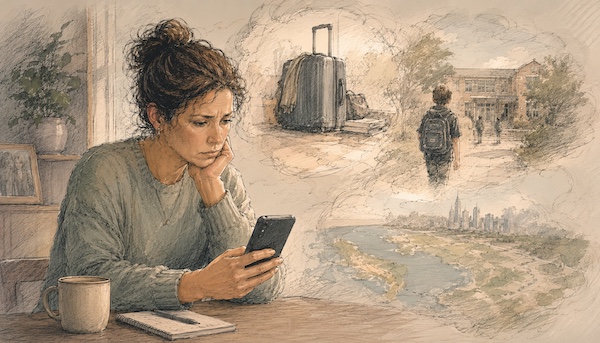
What I do differently now
Now when I see a headline like that, something stirs.
I feel it. A tightening, just below my ribs.
And then this little voice in my head: Wait. Let's see.
That's the whole thought. I haven't read the article. I have three words. And I've been down the other road enough times to know what it costs me.
Sometimes I close the app right away. I'm not ready yet, and I know it. I'm not ashamed of that. Sometimes I need to get into a better place first, and then go back and read what it's actually about.
Because most headlines are about what might happen. What's being proposed, discussed, planned. Even when something is already in motion, I don't know yet how it actually lands. What it will mean for my child. For our life. For Tuesday morning.
In Guatemala, they've proposed banning basic sex education more than once. Things that would make my work (I'm a sex educator) effectively illegal. And at the more extreme end, banning gender-affirming care and education, which would make my kid's existence illegal.
The first few times, I completely freaked out. I spent everything on it. And then it never went anywhere.
All that energy.
The threat is real. I'm not pretending otherwise. But right now, I go by one sentence: my future self will know what to do.
I know there are parents who see that headline and immediately start organizing. Who know exactly where to go and what to do. I admire them. I genuinely do.
I'm not one of them. It took me a long time to stop feeling guilty about that.
My version of showing up is quieter. It starts from the inside. I can't come from outrage and do anything useful.
Why two parents can see the same headline and respond so differently
What baffled me was seeing another parent. Someone in the same situation, seeing the same headlines. Just ... calmer. Seemingly less bothered. They would see something and not unravel.
Why were we responding so differently to the same thing?
Because the headline wasn't landing on a blank slate.
Some of what we're reacting to belongs to today. The threat can be real. But the intensity of our response is also shaped by everything we've learned before this moment: about danger, powerlessness, uncertainty, whether we're able to protect the people we love, whether we're enough.
That's one of the things that comes up in hypnotherapy again and again. People are surprised by the connections. They would never have drawn a line between something that happened when they were six and the panic they feel reading a headline today. Or between a moment of powerlessness decades ago and the tightening they feel right now.
The situations can look completely unrelated. But underneath, they can touch the same old fear.
What that is for you, I don't know. Your story is yours.
But for me, there was already something there before I ever opened the app.
And once that changed, my baseline changed too.
When something hits now, it can still hit hard. It just doesn't knock me over anymore. The world doesn't dictate my state the way it used to.
I don't have a better word than freedom. I still feel what's happening around me. Of course, I do. But somewhere between what happens and where I go with it, I have more choice than I had before. That is not a small thing.
There is more room now.

I've had one of those connections catch me completely by surprise. That's the story behind What My Body Knew Before I Did.
When staying informed starts feeling like protecting your child
I used to think staying alert was the responsible thing. That if I let my guard down, even for a moment, something would slip through. That constant vigilance was keeping us safe.
I thought staying on top of it all was protecting my child.
I had to ask myself: am I paying attention because information helps me act? Or am I paying attention because some part of me believes constant vigilance will prevent something bad from happening?
Those are not the same thing.
One gives me information I can use. The other just keeps me on watch.
To be there for my child when it actually matters, I need to have something left. I can't spend all of myself preparing for things that haven't happened.
I call some of this pre-suffering: spending today on something that may or may not happen tomorrow. I wrote more about it here → Stop Pre-Suffering: A Hypnotherapy Tool for Parents of Transgender and Nonbinary Children
Why reasoning my way to steadiness never worked
I didn't get here by convincing myself there was nothing to worry about. There are things to worry about. And I've done enough thinking for several lifetimes anyway. I'm very good at it.
The problem was that logic could only take me so far. Hypnosis gave me another way in. A way to work with what logic alone couldn't reach.
The world didn't become less uncertain.
I became steadier in it.
And really, that's the whole point. I can read the same headline now and still feel that tightening below my ribs.
I can still think, Oh shit.
I can still be angry. Or scared. Or decide that yes, this one needs my attention. But I don't have to go all the way into a future that hasn't happened yet.
I can wait. I can find out what is actually true. I can put the phone down and make coffee.

And if something really does need me, my future self will know what to do.
It means the headline still lands.
It just doesn't get to spend all of me.
If any of this resonated, and you want to talk, I'm here.
Visual Transparency: All images in this article were generated via DALL-E to illustrate the concepts discussed.