What If Your Partner Isn't On Board?
On slow arrivals, mama bear energy, and the grace it takes to wait.
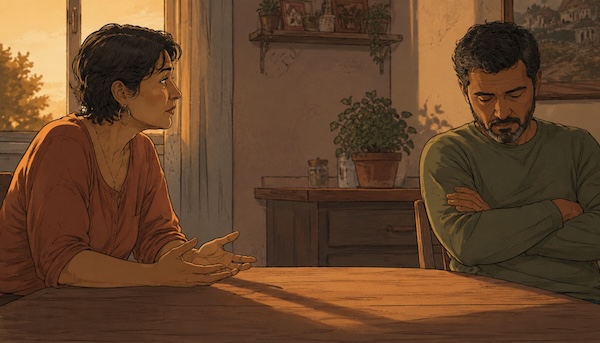
You weren't asking for anything. You just wanted to talk about your child — not next steps, not the school, not the doctor. Just: what is this like for you? You opened your mouth and felt the room change before the first word was out.
You tried anyway, and before you'd finished the sentence, you were already in an argument you didn't start.
For a while, just bringing up your child's experience feels like striking a match near something flammable. That was already too much.
If this sounds familiar, this one's for you.
The spectrum
When I look at the families I've encountered, I see roughly three different places a partner can land.
The first is what I just described: a partner who isn't rejecting their child, but who isn't ready to talk, process, or engage with what's happening yet. It takes them longer to get there. Months, sometimes. There's resistance — not to the child, but to the feelings and the conversations around the child. It looks like shutdown. It feels, to the parent who is ready, like abandonment.
The second is harder. A partner who says no. An actual refusal to use the right name, to support next steps, to affirm the child's identity. Relationships fracture here. Sometimes custody enters the picture. Sometimes the choice really does become the child or the marriage.
And then there's a third situation that doesn't get talked about enough: both parents aligned, from the beginning. Genuinely on the same page. It happens. It's not the most common story I hear, but it's real, and it's beautiful when it is.
Most of the parents I talk to are somewhere in the first category, wondering if they're about to end up in the second.
The mama bear factor (a theory, not a verdict)
Here's something I've noticed — and I want to be honest that this is an observation, not a clinical finding.
Mothers tend to get there faster.
The mama bear reflex doesn't calculate. It doesn't weigh identity politics or what the neighbors think. It just orients toward the child.
Not always. Not universally. But in my experience, and in the patterns I see in this work, there's something that activates in mothers early on that seems to override everything else.
I sometimes wonder whether the parent who spends years being the default emotional responder — the one who handles the worry, the school calls, the 2am fears — develops a reflex that fires very quickly when a child is hurting. In many families that's the mother, though certainly not always.
In what I've read and in what I keep hearing from families: fathers tend to be among the last to know, and the most likely to meet the news with initial resistance — particularly fathers who hold tightly to traditional ideas of masculinity. But I hold that lightly. There are fathers who show up immediately, beautifully, without hesitation. And there are mothers who don't. This isn't a verdict on anyone.
When I became a mother, something rewired. And I think for a lot of us, that rewiring runs deeper and faster than we sometimes know — until suddenly we're defending something that matters more than anything else ever has.
The thing I almost did
There is a moment — and I think a lot of moms know this moment — where you look at the situation and think: If you're not in this with me, I will do it alone. Because this matters more.
I won't pretend I didn't get there. I did.
There's something clarifying about that moment, actually. It tells you something real about yourself: that you will not compromise on your child, no matter what. That is not a small thing to know.
But here's what I learned in the months that followed: for a lot of partners, slow is not the same as no. The hard part is that while you're waiting, it feels exactly like no.
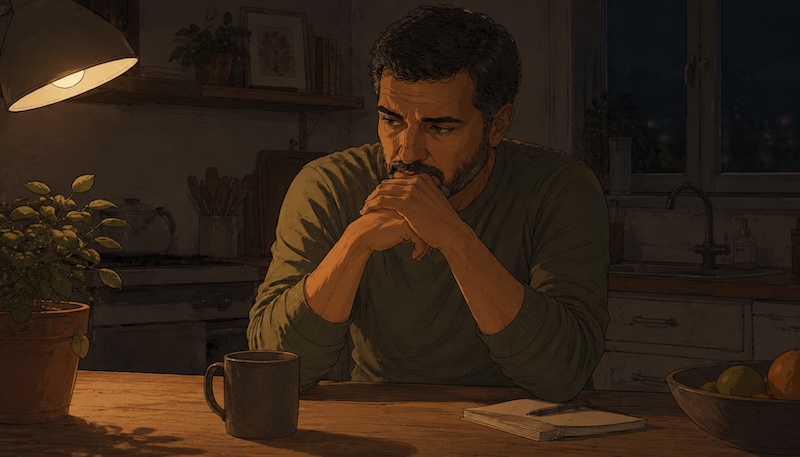
The shutdown, the arguments, the inability to have the conversation — that's not necessarily rejection. That can be fear wearing a hard face. It can be grief that hasn't found a language yet. It can be someone processing something enormous in the only way they know how, which is privately, badly, and way too slowly for your timeline.
I know it doesn't feel like that when you're in it. It felt, to me, like I was being abandoned at the exact moment I needed someone to stand next to me. But looking back, it was also someone drowning in their own reaction, with no idea how to surface.

Space and grace — if you have any left to give
I know how that sounds.
It falls on us again. The one who was ready first has to wait for the one who isn't. The one managing their own overwhelm also has to find patience for someone else's. This is not new. It is also not okay, and also somehow still true.
If you have anything left to give, genuine space goes a long way — the kind that has no strategy in it, just a real I see you're not here yet and I'm not leaving. Further than you'd expect.
And if you don't have that right now — if you're running on empty and you simply cannot hold one more thing — that doesn't make you a bad partner. It makes you human, and exhausted in a way that's very hard to explain to someone who isn't living it.
Exhaustion can make us want to quit sooner than we otherwise might. It makes it hard to hold steady, and a partner who can't have the conversation can feel like just one more thing that isn't working. One more thing to carry.
The cruelest part is this: there's no way to know in advance whether a partner is moving slowly or moving away. That's what makes this so hard. You're being asked to give grace to a situation where you can't yet see the ending.
Sometimes the relationship really doesn't make it. I'm not going to pretend otherwise.
But sometimes it does. And the partners who eventually come around — and there are a lot of them — often needed someone to stop pushing long enough for them to move.
You may not have to choose
If you're in the middle of it right now — the arguments, the silence, the loneliness of carrying something this big without the person you expected beside you — I want to say this clearly:
Wanting them there is not a betrayal of your child. And doing it alone, if it comes to that, doesn't mean you did something wrong.
The choice between your child and your relationship is real, and sometimes it does come to that. But a lot of the time, it doesn't have to. A lot of the time, what looks like "not on board" is actually just "not there yet."
Sometimes the person beside you needs time to catch up. Sometimes they don't. But a slow arrival is not the same thing as absence. And while you're figuring out which story you're in, you don't have to carry all of it alone.
If this is living somewhere in your body right now and you'd like to talk it through, the Anchor in the Storm Call is a free 45-minute conversation — just the two of us, no agenda, no pitch.
Visual Transparency: All images in this article were generated via DALL-E to illustrate the concepts discussed.