What If Your Child Keeps Changing Their Gender Label?
When your child keeps changing their gender label, it doesn't necessarily mean they were wrong before.
Your child tells you they identify as nonbinary.
Okay.
You learn what that means. Maybe you change pronouns. You read things. You practice. You get used to it. And then, six months later, they tell you something else.
Actually, I think I'm trans.
Or genderfluid. Or maybe they don't want a label at all anymore.
And somewhere in your head, a little voice starts up.
Wait. I thought we had figured this out.
Maybe you wonder whether you took the first label too seriously. Maybe they're confused. Maybe you should wait this time before changing anything. Because what if this changes again?
I understand the impulse. But I think we're asking labels to do something they were never meant to do.
Your child is figuring out who they are
Kids grow up trying to answer a rather enormous question: Who am I? We all did.
What kind of girl am I? What kind of boy am I? What kind of person am I? What do I like? Who am I attracted to? What feels like me and what am I doing because everyone around me seems to expect it?
Some of us never had to question the first word in that list. I knew I was a girl. I didn't have to think very hard about that part. That didn't mean I had myself figured out.
Not even close.
I still had to figure out what being a girl meant to me. And then what kind of woman I wanted to be. Which expectations fit me and which ones I had absolutely no interest in.
I'm still figuring things out.
For a transgender or nonbinary child, gender itself may be one of the things they're figuring out more explicitly. So instead of only asking What kind of girl am I?, they may first be asking Am I a girl? Or: Am I a boy? Or: Neither? Both? Somewhere in between?
And fortunately, they have more words available to them than generations before them did. That can make the process more visible to us as parents.
Sometimes you need the word before you know whether it fits
A child may discover the word nonbinary and think:
Oh. That's me.
And maybe it is. Maybe that word finally gives them a way to explain something they've been feeling for years.
Or maybe living with that word helps them notice something else. Maybe nonbinary was closer than girl, but after a while boy feels more accurate. Maybe trans fits but boy doesn't. Maybe a very specific label fits at fourteen and a different one fits at eighteen.
That doesn't automatically mean the first word was fake. And it doesn't necessarily mean they're confused.
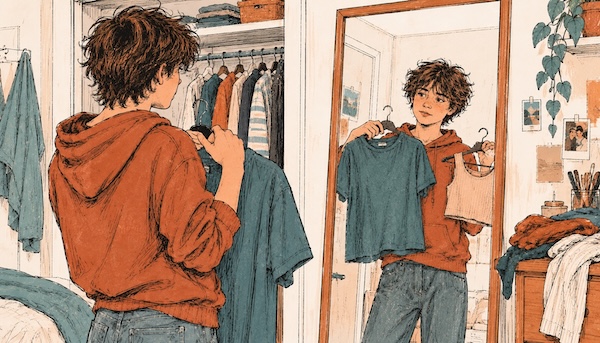
Sometimes we only find out whether something fits by trying it on.
You don't have to know whether this label will last
I think this is where we parents can accidentally make things much harder than they need to be.
We want to know. Is this it now? Are you sure? What if you change your mind again?
Partly because we have things to do with the information. There may be a new name to remember. Pronouns to practice. Family members to tell. School forms. Conversations.
We would quite like the final version, please.
Unfortunately, children don't usually hand us the final version of themselves. Neither do adults, for that matter.
So perhaps we don't need to decide whether this is the label our child will use at 25. We can listen to what they're telling us at 12. Or 15. Or today.
If your child told you six months ago that nonbinary described them, taking that seriously wasn't a mistake just because they use a different word now. You responded to the child who was in front of you.
Now they're telling you something new. You can respond to that too.
And yes, another change can mean another round of getting used to a name or pronouns. Even when you're completely on board, your mouth doesn't always catch up immediately.
Why You Still Get Your Child's Pronouns Wrong Sometimes
Changing a label doesn't erase what came before
I think sometimes we're afraid that if our child changes their label, it means we all got something wrong.
But human beings change their understanding of themselves all the time. We learn things. We meet people. We discover that other people experience something we thought was only us. We find language we didn't have before. We get older and realize that something we were completely certain about at thirteen looks different from where we're standing now.
That's growing. Gender can be part of that.
And yes, sometimes a child may try a word and eventually decide it doesn't fit.
What they need is enough room to figure out who they are. Without the pressure of choosing the correct box as quickly as possible. Which may include a few different words along the way.
You don't have to tattoo each one on the family crest. But you can take it seriously while it's theirs. And if another word fits better later, you can take that one seriously too.

Visual Transparency: Illustrations in this article were created using generative AI.