
The Siblings Have a Story, Too: When Your Child Has a Trans or Nonbinary Sibling
Siblings of trans and nonbinary kids have a story of their own. Sometimes it's easy, sometimes it's hard, and often it's somewhere in between.
My daughter was still very young when people outside our family started having questions about her sibling's gender.
Inside our home, though, there was no big family conversation. No announcement. No moment when we all sat down and tried to figure out what this meant.
We talked about gender and sexuality the same way we talked about everything else. Not in lectures or carefully planned educational moments (thank goodness), but as part of everyday life. Clothes were clothes. Toys were toys. And children were children.
For my daughter, her younger sibling was simply the person she'd grown up with. Someone to play with, laugh with, defend fiercely when necessary, and find spectacularly annoying the rest of the time.
But I also know that this isn't every family's experience. Some siblings barely notice that anything is different. Others carry quite a lot. And as parents, we don't always know which one we're looking at.
In this article
"If anyone messes with them …"
Sometimes it's just siblinghood
Not every sibling has the same story
Every child deserves to be seen
Getting to know your other child's story
"If anyone messes with them …"
There's a sentence my daughter said more than once over the years.
"If anyone messes with them, they'll have to go through me."
She meant it. Every single time.
At school, other kids sometimes asked her about her sibling. Is that your brother or your sister? Which one is it?
Her answer was always the same.
"Go ask them."
I love those two sentences together. One is loyalty. The other is a boundary. She was ready to stand up for her sibling any day of the week. And she was not going to explain who they are on their behalf. That was their story to tell.
Now, I'm her mother, so of course I'm proud. But I also asked myself sometimes: how much did those questions weigh on her?
She handled them well. Quick, clear, done. But being able to handle something and never having had to carry it are two different things.
Now you might say: why not just ask her? And you're right. I can. As far as I know, those questions mostly belong to when they were younger. Things have settled since.
But writing this makes me think I should ask her again. Maybe now she'd put it differently, or remember it differently. Who knows?

Sometimes it's just siblinghood
My two love each other immensely. They defend each other. They share a sense of humour the rest of us don't always get.
And sometimes they cannot stand each other.
As they got older, each of them took a turn complaining that the other one wasn't the same anymore. First the younger one complained about the older one. A few years later, it was the other way round. (Fair enough. Teenagers change. They both did.)
That's sibling life. It happens in every family.
Which makes me wonder whether we sometimes get so focused on gender that we forget these children are also, quite simply, siblings. Not every argument, every slammed door or every bit of jealousy has to do with gender identity.
My daughter lost some of our attention the day her sibling was born. That's hardly unusual for a firstborn. It was simply about a new baby in the house. Gender didn't come into it.
So when your other child is moody, it's worth asking honestly. Is this about their sibling's gender? Or is this about being nine? Or fourteen? Or about having a sibling at all?
Not every sibling has the same story
Ours is one family. For many siblings of trans and nonbinary kids, things look different.
A small 2024 study that interviewed 15 siblings of trans young people found a similar range: many had sensed something before their sibling said anything, and they talked about changes in the family, worry for their sibling, and worry about themselves.
One sibling barely gives their sibling's gender a second thought. Another gets questions at school, week after week, and has to decide each time how much to say.
There are siblings who watch their parents worry, argue, or go quiet at the dinner table. Or who see their sibling treated unfairly by people they know (a teacher, a grandparent, a friend's parent) and don't know where to put that.
A child might become fiercely protective. Or quietly decide to be the one who never causes any trouble. Or get angry, loud, or withdrawn.
And some are honestly fine.
That last one deserves just as much respect as the others. A child who seems fine might really be fine. We don't need to go digging for hidden suffering.
When a family's attention and energy are stretched, children respond in different ways. Their needs might be very visible. Or so well hidden you'd never guess. And when a child is struggling, there can be many reasons behind it. Their sibling's gender may be one of them. Or none of them.
And then there's the child who seems to be doing just fine. The one who never asks for much.
They notice their parents coming home from another school meeting with tight faces. They hear the phone calls that go quiet when they walk in. They see how tired everyone is at dinner. And somewhere along the way, they decide that their own problems can wait.
So they do their homework without being asked. They don't mention the friend who stopped talking to them. They say "I'm fine" before anyone has finished the question.
From the outside, this looks remarkably like maturity. Teachers praise it. Relatives say what a sensible kid they are. And we're quietly grateful, because it's one less thing.
Sometimes it really is maturity. Sometimes it's a child who has learnt there isn't much room for them right now … and has made themselves smaller to help. Both can look exactly the same at the dinner table. Which is why it's worth keeping the door open, even after the first "I'm fine."
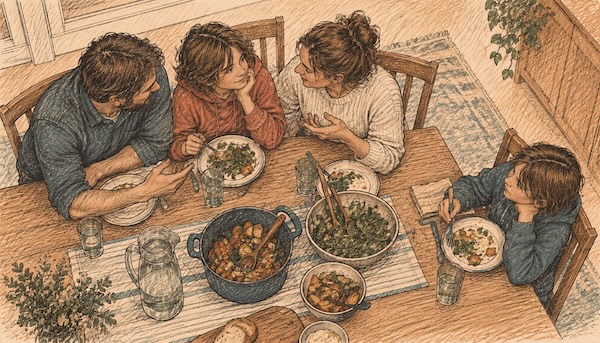
Every child deserves to be seen
Every child in a family has a right to attention. To be asked how their day was, and to have someone actually listen to the answer. Obviously.
That gets harder when the world around one child makes their life very complicated and, at times, very heavy. A school that won't use the right name. An appointment that took months to get. A relative who said something at a birthday party. Of course your attention goes there. It has to.
And the other child notices. Children notice everything.
It doesn't have to turn into a pattern, though. The attention doesn't need to be perfectly even. It needs to be there, for each of them, in a way they can feel.
Now you might say: I barely have enough left for one child right now, let alone two. And you're right, you can't do everything. You don't have to. Ten minutes that belong to only one child can count for a lot.
You can only spread your attention as far as your own reserves allow. That's the "without losing yourself" part of How to Support Your Transgender Child (Without Losing Yourself, and it counts for every child in the house.
Getting to know your other child's story
We can't know what a child experiences just because they have a trans or nonbinary sibling. We have to get to know it, even when it's a child we've known since the day they were born. What We Don't Know About the People We Live With is often more than we'd like to admit.
That means asking, and then listening without already knowing the answer.
Some of the best conversations happen in the car. You're driving back from something ordinary, a dentist appointment, a grocery run. Side by side, nobody looking at anybody, no one else in the back seat. You might ask, quite casually, whether kids at school ever ask about their sibling. And what they say when they do. Then you keep your eyes on the road and let the silence do some of the work.
If they do get asked, let them know they don't have to explain anything. They are not their sibling's spokesperson. "Go ask them" worked for my daughter. "That's not mine to tell" works too, and so does changing the subject.
Not every child feels comfortable saying any of that, though, and some questions don't stay at curiosity. When the questions keep coming, get personal, or turn mean, a child shouldn't be left to handle that alone. That's where you step in: a word with the teacher, a call to another parent, or simply telling your child, "Next time, send them to me."
Sometimes what comes out in those conversations is mixed. Proud one moment, embarrassed the next. Fiercely loyal, and also fed up with how much everything seems to revolve around one person. Both can be true at the same time, and neither makes them a bad sibling. Something as simple as "That makes sense. You can love \[name\] and still be tired of all of this" can let them set it down for a moment.
And then there's time that belongs only to them. A walk to the shop, a card game, a late-night snack. Ten minutes where their sibling doesn't come up unless they bring it up.
If your other child tells you they're fine, believe them. Just keep the door open.
None of this needs to become another project on your list.

Two stories that overlap
My two still tease each other mercilessly. They still laugh at the same ridiculous things. Some days they're each other's fiercest defender, and some days they can barely share a bathroom.
My daughter has her own story. My youngest has theirs. Those stories overlap, and they aren't the same.
Your children have their own stories, too. Mine are still telling me theirs.
Visual Transparency: Illustrations in this article were created using generative AI.