The People Who Surprise Us
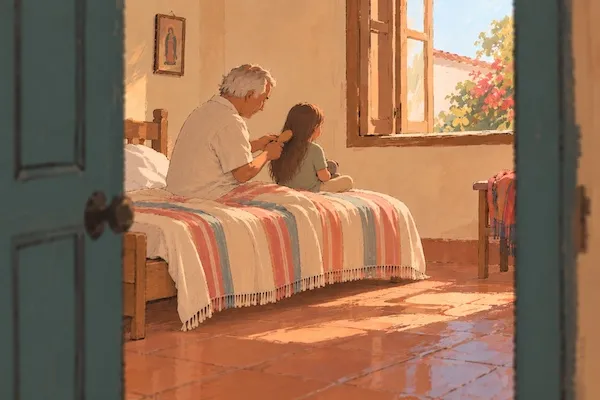
I walk into my in-laws' bedroom and stop in the doorway. There, sitting on the bed, is my father-in-law, well into his eighties, brushing my little one's long hair. They're still so little. He brushes gently, carefully, the way you do when you have all the time in the world.
I remember how unexpectedly beautiful it was, and how I immediately felt tears coming to my eyes.
Because this is the same grandfather who occasionally teases my child about their hair. Let's cut it, it'll be easier. Nothing harsh. Just the kind of teasing that happens in families.
But I'm a parent who notices these things. Probably too much sometimes.
I don't know if that's my personality or if it comes with being the parent of a gender-diverse kid. Probably both. We get very good at hearing comments. A little alarm goes off somewhere in the chest. Is it just playful? Is there something else? How did my child take it? Did they even notice? I watch my kid's reaction. Sometimes I ask afterward whether something bothered them. Other times I decide to leave it alone.
I grew up with this too. My grandma always had something to say about my clothes or my hair. I never felt it as rejection. It was one generation looking at the next and having opinions, as generations do.
But that day, standing in the doorway, there is nothing to figure out.
Just an elderly Guatemalan grandfather brushing his grandchild's hair with such tenderness.
I don't know what he thinks about gender diversity. I don't know whether he understands all of it, or whether he even feels the need to.
And in that moment, I don't need to know.
It's simply beautiful.
The people we've already made up our minds about
We decide early who will have a hard time with our kids. Older means harder. Religious means harder. Conservative country, small village, a certain kind of family. Harder, harder, harder.
Sometimes we're right. Some families get exactly the rejection they were afraid of, and some of you reading this are living with that right now. I know we've been lucky. My mum accepted it from the start. My dad never said a word against it. Even the relatives who find it harder have never been unkind.
Is it still dresses?
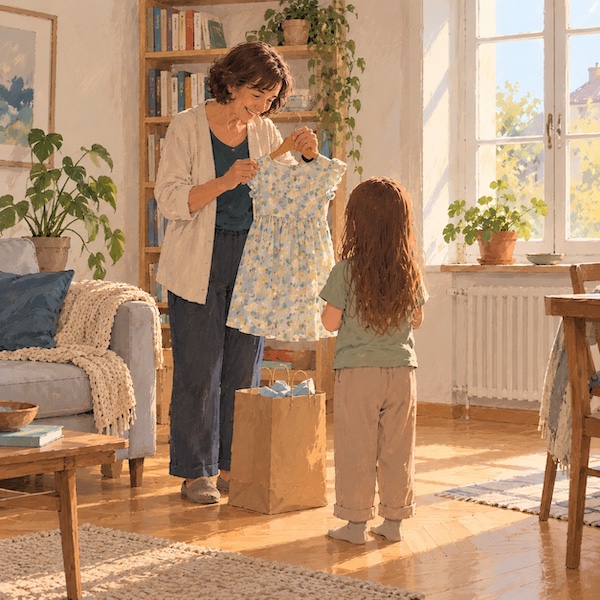
When my kids were little, my aunt in Germany always bought clothes for them when we came to visit. The first time, she gets it wrong for my little one. No explanation needed. She sees the disappointment on their face, goes back out to the shop, and comes home with a dress.
After that, every visit, she checks. Is it still dresses?
I love that question. So simple.
She asked what they liked, and then she asked again the next time, in case the answer had changed.
Oh, that's easy
When my child was ready to use a different name and pronouns, we arranged a meeting with the new secondary school director. I had prepared myself for a conversation. Maybe explanations, maybe questions, perhaps some resistance. You know, all the scenarios we parents can rehearse in our heads before we've even entered the room.
It's one of the shortest meetings I've ever had. Here's the name. Here are the pronouns. Please change them.
She says, Oh, that's easy.
That's easy. She says it more than once.
We meet on a Friday. By Monday, every teacher is using the new name and pronoun. And once the teachers do it, the kids do too.
Even the teachers who aren't exactly my kid's favorites came to apologize when they slipped. Twice, that I know of. They like them a bit more now ;-)
Three words. I still think about them.
Fifteen years in a "conservative" country
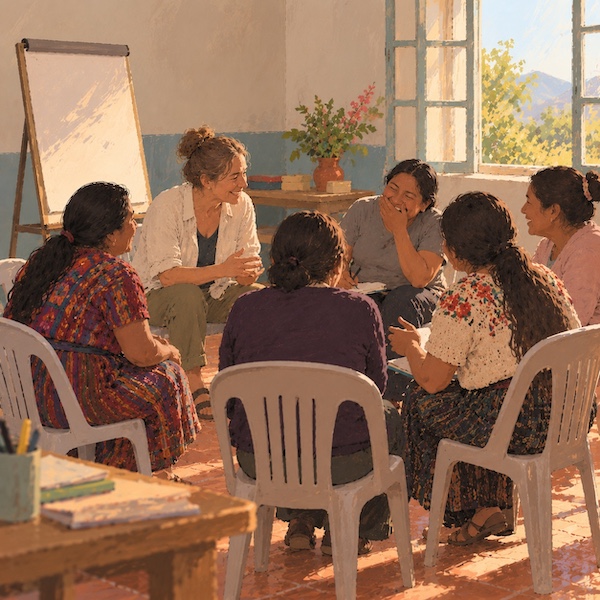
I've been teaching sex education in Guatemala for more than fifteen years. People abroad are amazed when I tell them. But the ones who really can't believe it are often Guatemalans themselves. That must be so hard. People here aren't open. And the religion …
Sometimes I say, Stop saying that. Have a little more faith in your own people. It isn't my experience.
Now, there's an important detail: I go where I'm invited. I'm not showing up unannounced in villages with a suitcase full of anatomical models and demanding that everyone listen to me.
That certainly helps.
But what I encounter, again and again, is curiosity.
People ask questions. They share experiences. They want to understand things.
And when I talk about sexuality, I naturally include diversity. I sprinkle it in, next to everything else, because that's where it lives. No big announcement, not as a separate topic.
And people recognize it. They tell me about someone in their village who wears dresses, or men who have relationships with other men. They share observations from their own communities.
Sometimes I'm surprised by how casually they talk about it.
"Oh yes, we have that here, too."
Of course they do.
Sometimes someone says, "But we didn't have that before." And I wonder how many people they've known throughout their lives who simply couldn't show that part of themselves.
Because what people see is only a fraction of what exists. Not everyone feels free to be open about who they are, and often for very good reasons. And yet, even in remote communities, there are people who are visible, at least a little. Younger generations are sometimes more open about it, too.
Imagine how ordinary all this might have become long ago if people had always been free to live openly.
Gender and sexual diversity didn't suddenly arrive in Guatemala because someone started talking about it in a workshop. They've always been part of human life.
But I think we sometimes underestimate people's capacity for curiosity, understanding, and change.
We look at a country's laws, its dominant religion, or its reputation and assume we already know what the people living there think.
But a country isn't one person. Neither is a generation, a religion, or a community.
Leaving a little room
I'm still the parent who hears the little comments. Who watches the reactions. Who sometimes prepares for conversations that never actually happen.
I don't think that's going to change completely.
But these experiences have reminded me that my expectations aren't always reliable.
Sometimes the person I thought might struggle turns out to be the one who makes things surprisingly easy.
And sometimes, while I'm busy wondering what someone might be thinking, they're simply sitting on a bed, brushing a child's hair.
Visual Transparency: Illustrations in this article were created using generative AI.