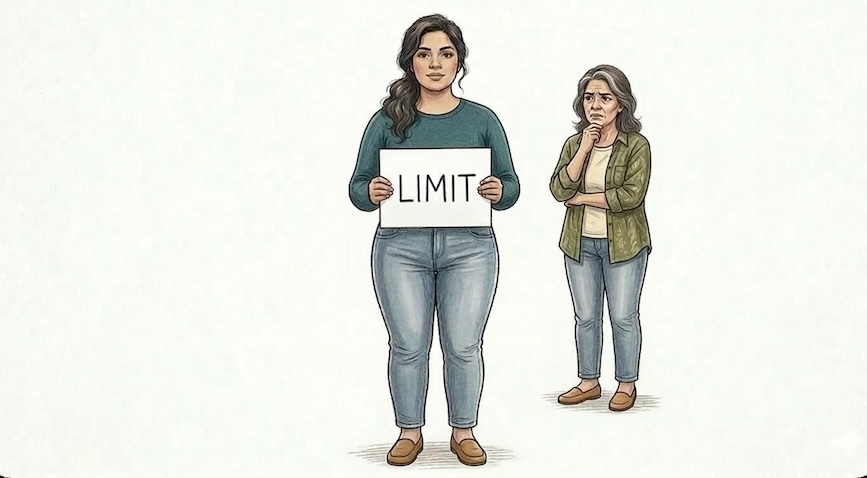
Why Setting Limits with Family Feels So Hard (and How to Hold Boundaries)
You can hold your ground with a coworker and barely flinch. So why does the same conversation with your mother feel like a five-alarm fire?
Quick Summary
Setting a limit with a family member should feel like self-respect. Instead, it often leaves you with a strange, unsettled feeling — second-guessing yourself, wondering if you were too harsh, or feeling the urge to smooth things over.
This article explores why that reaction can be so strong when the other person is family — and why that feeling does not mean you did something wrong.
You will learn what is actually behind the pull to fix the moment, how to stay steady when it shows up, and what to do afterward, so it does not end up making the decision for you.
Table of Contents
1. Why Boundaries Feel Different With Family
2. The Pull to Protect the Connection (And Why It Is Not Weakness)
3. The Relief Trap: When the Urge to Feel Better Drives the Decision
4. The Difference Between a Limit and a Wall
5. How to Set Boundaries With Family Without Starting a Fight
Simple Boundary Scripts for Family Conversations
Introduction
You say it quietly.
"We're not going to talk about that in front of them."
The table goes a little still. Your mother sighs. Someone reaches for the salt. Another person changes the subject. And for a brief moment, you wonder if you just made everything worse.
By any reasonable measure, you handled it.
You said what needed to be said. You protected your child. You stayed calm.
And then the second-guessing starts.
Was I too harsh? Did I overreact? Maybe I go back and smooth it over.
Often there is a strange feeling that shows up right after a moment like this. A tightness in your stomach. A pull to fix things. A sudden urge to make everyone comfortable again.
Sometimes it is sharp and unpleasant, like you did something wrong. Sometimes it is quieter — just the weight of realizing that someone you love did not like what you just said. Either way, it can be surprisingly disorienting — especially when you know you did the right thing.
This article is about that moment. Why setting limits with family can feel so much harder than with anyone else, what is actually happening underneath that pull to smooth things over, and how to stay steady even when the feeling shows up.
Whatever you call it — setting limits, holding boundaries — when you are inside the moment it feels less like a concept and more like a very real emotional test.
Because caring about your family and holding a line for your child are not opposites.
But in the moment, it can certainly feel that way.
1. Why Boundaries Feel Different With Family
You probably do not feel this way when you set a boundary with a neighbor, a coworker, or even a close friend. You might feel unsettled, but not undone.
Family is different. And there is a reason for that.
When we are around family, something older than logic kicks in. These are the first people who were supposed to shape our sense of being loved, included, and safe. Whether they did or not, that longing stays with us. That history does not disappear just because we are adults with our own homes and our own children. It sits in the room with us.
So when we say something a family member does not want to hear—when we redirect a comment, leave a conversation early, or hold firm on something they disagree with—it does not just land as a disagreement.
It brushes up against something much older: the fear of being pushed out, misunderstood, or seen as difficult by the people who were supposed to be in your corner.
That fear is not irrational. It is not weakness.
It is what happens when the stakes feel genuinely high—because with family, they often are.
Understanding this does not mean backing down. It means you can stop asking “Why is this so hard?” and start asking “What do I actually need right
This is the deeper dive into family boundaries that Parenting Through Noise: Navigating Family Pressure points to — if you haven't read that one yet, it's the broader map this article fits inside.
2. The Pull to Protect the Connection (And Why It Is Not Weakness)
When you hold a limit with a family member and feel the immediate urge to soften it, take it back, or apologize — that pull is not a character flaw.
Sometimes it is the part of you that loves them. Sometimes it is the part of you that is still hoping they will come around. Sometimes it is older than either of those things — a reflex that learned, long ago, that their approval mattered more than your comfort.
Most of us grew up in families where harmony was the goal — even the good ones.
We learned—often without being told—that keeping certain people comfortable helped keep the peace. That certain topics were better avoided. That the emotional temperature of the room was something you could manage if you were careful.
That way of moving through family life was not wrong. In many ways, it was generous.
But it left a mark.
Because now, when you do something that disrupts that harmony—even when the disruption is necessary, even when it is the right call—your whole history with that family says:
Fix it.
Smooth it over.
Do not let the silence stretch too long.
The problem is not that you care about the relationship.
The problem is when that caring gets turned against you in the moment — when the weight of holding a line becomes the reason you let the line go.
Because two things can be true at the same time.
You can love your family.
You can still refuse to let harmful things be said in front of your child.
Those two things are not in conflict. They just feel that way in the moment.

3. The Relief Trap: When the Urge to Feel Better Drives the Decision
Here is where it gets tricky.
What follows holding a limit with family is real, whatever it is. A wave of self-doubt. The urge to undo the moment. Something that sits in your chest and doesn't quite settle.
And because it is real, it is very easy to let it do the driving.
When we back down from a limit, we tell ourselves:
I do not want to cause a scene.
They mean well.
It is not worth the fight.
I just do not want them to feel bad.
These feel like reasonable thoughts. They sound like empathy and patience.
But when those thoughts become the reason you let a harmful comment slide — especially one said in front of your child — that is often a sign that the urge to feel better is starting to make the decision for you.
The cycle usually looks like this:
You hold a limit.
The other person becomes uncomfortable.
You feel somehow bad.
This feeling becomes hard to tolerate.
You back down to make it stop.
Step five does bring relief — temporarily.
But the relief fades. And what remains is the original hurt, plus the knowledge that the line moved.
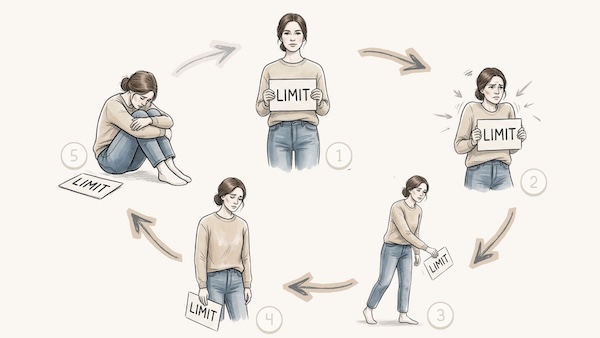
Getting out of that cycle does not take willpower. It takes learning to sit with someone else's reaction long enough for your own clarity to return.
That is a practice, not a personality type.
If that cycle sounds familiar — not just with family, but across the board — it may be worth reading Parenting When Everything Feels Overwhelming, which looks at why the baseline is already so high before these moments even begin.
4. The Difference Between a Limit and a Wall
One reason this hits so hard is that we associate holding a limit with cutting people off. With being cold. With the kind of rigid move that ends relationships.
That is not what a limit is.
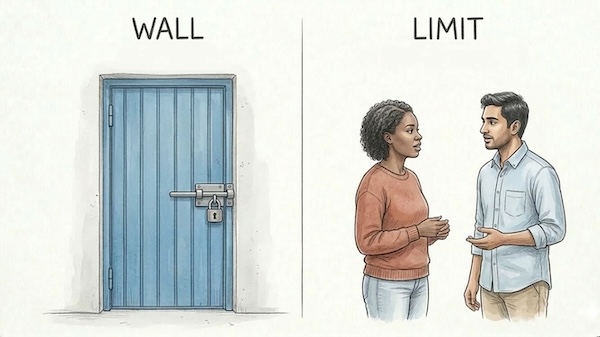
A wall says:
"I am done with you. I am not letting you in."
A limit says:
"I care about this relationship enough to tell you what I need for it to keep working."
Walls are final. Limits are ongoing. Walls protect you from connection. Limits protect you inside of it.
This matters enormously when you love your family — even when your family is difficult.
You are not trying to end the relationship. You are trying to make it survivable for everyone, including your child.
When you say to a relative, "Please do not make comments like that about my child in front of them," that is an act of love. Love for the child whose ears are in the room. And, in a longer view, love for the relationship itself.
What follows may whisper: You hurt them. You were unkind.
A more accurate reading is simply this: they are unsettled.
Unsettled is not the same as being hurt.
5. How to Set Boundaries With Family Without Starting a Fight
Knowing all of this does not make the words easier to find when someone is sitting across the table from you.
These scripts are for the moments that tend to undo us. They are not about being sharp or cold. They are about being clear enough that you do not have to keep revisiting the same conversation.
Simple Boundary Scripts for Family Conversations
When you feel the pull to over-explain
The more we explain, the more we invite debate.
"This is where we have landed on this."
"I know it is different from how you would do it — this works for us."
"I am not looking for feedback on this one, but I appreciate that you care."
When the wave hits mid-conversation
Pause. Breathe. Finish your sentence. "I know this is not easy to hear. I need us to move past this topic for today." Silence is allowed.
When they push back
Repeat calmly.
"Like I said, we are not going to discuss this today."
"I hear that you feel strongly. This is still where we stand."
When something is said in front of your child
"We do not make those kinds of comments about [child's name] in our family."
"I am going to ask you not to say that again in front of them."
If it continues:
"We are going to step out. We can reconnect when that is off the table."
6. After: What to Do When It Stays With You
Holding a limit does not end the experience. In many ways, the hardest part is the hour — or the day — after.
You may replay the conversation. You may feel the pull to repair it immediately.
This is normal. It does not mean you were wrong.
Three ways to handle the aftermath:
1. Say it plainly to yourself
I held a limit today. It was hard. I am sitting with that.
2. Let your body finish the moment The tension lives in the body. Tight shoulders. Clenched jaw. Heavy stomach. A long exhale. A shake of the hands. A short walk.
These small movements help your body settle again.

If the noise inside is still loud, that is exactly what the Peaceful Warrior Calm Audio was designed for — a short guided pause to help you come back to yourself.
3. Check in with your child
If your child was present, they may be holding something quietly.
You can say:
"What happened earlier was not your fault."
"I said what I needed to say. I would do it again."
"How are you feeling about it?"
The limit you set becomes meaningful when your child sees you stand by it.
If you find yourself carrying angious feelings about how the moment landed for your child, Holding Fear for Your Child Without Passing It Down is a good next read — it's about staying steady for them without pretending everything is fine.
Conclusion: This Doubt Is Not a Stop Sign
Something will come after the moment — some version of self-doubt, or the pull to undo it, or just the weight of having disrupted something familiar. That part is not in your control.
What is in your control is what you do with it.
You can let it undo the words you just said.
Or you can recognize it for what it actually is: the part of you that loves your family, or longs for their approval, or simply learned long ago that keeping the peace kept you safe — meeting a moment where all of that had to make room for something else.
Holding a limit with someone you love is not a betrayal of the relationship. In many cases, it is the most honest thing you can do inside of it.
That feeling is not proof that you did something wrong.
Often, it is simply the feeling of doing something new inside a relationship that has followed the same patterns for a long time.
And the child watching you in that moment learns something powerful:
That love and limits can exist together.
That protecting someone does not require anger or distance.
And that sometimes the most caring thing you can do for a relationship is hold the line.
Visual Transparency: All images in this article were generated via Gemini to illustrate the concepts discussed.